The Power of Predictability
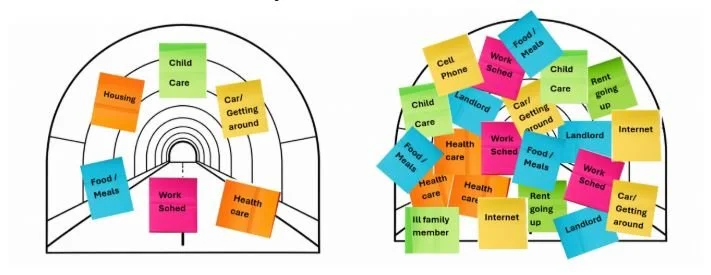
Society expects the person whose mental space is crowded (tunnel on the right) to do something biologically impossible – think and behave like a person whose mental space has plenty of slack (tunnel on the left).
The tunnel represents mental “space”, of which all humans have a limited supply. When things are predictable, they take up less space. A person does not have to think again and again about their work schedule if it does not change, for example.
The picture on the right shows the mental space of a person whose work, home, childcare, etc. are not stable and predictable. Every week, their work schedule changes. Every day, they take steps to get enough food. Their housing changes in an instant when the landlord decides to sell or gentrify or raise rent.
The crowded brain works differently from the uncrowded one. The executive function – which handles planning, strategizing, long-term thinking – gets fatigued and the brain shifts to less demanding skills. The capacity to do careful analysis or focus on a difficult task goes down. Immediate reward and simple solutions become more enticing. This is a biological process, not a mental one.
There is a trope that people are poor because they make poor decisions. Yet all people’s decision-making changes when the brain is fatigued. Sure, anyone who has an e-mail box makes a lot of decisions every day. The difference is that people coping with poverty are constantly juggling things that are beyond their control.
People with resources not only have more predictability in their lives, but also more control or “agency” to make careful, deliberate choices. Analyzing choices is a luxury that people do not have when they are fully occupied with meeting basic needs. No matter whether you call this a “bug” or a “feature” of the human brain, it’s reality. And the saying goes, you will lose when you fight reality but only 100 percent of the time.